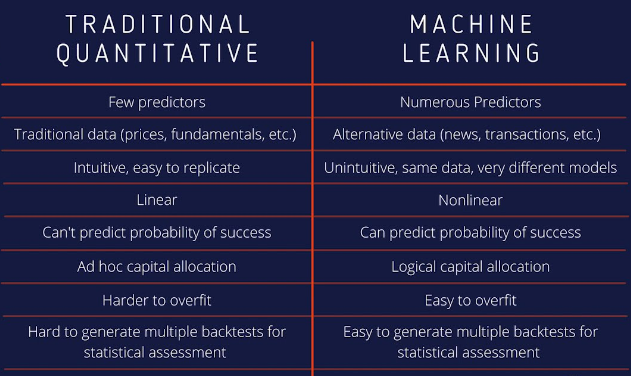
Quantitative learning, machine learning, and deep learning are related fields but have distinct differences. Here are some key differences between them:
- Scope and Focus:
- Quantitative learning: Primarily focuses on applying mathematical and statistical models to analyze financial data, make predictions, and optimize investment strategies in the domain of finance.
- Machine learning: Broadly refers to the development of algorithms and models that enable computers to learn from and make predictions or decisions based on data. It has applications across various domains, not limited to finance.
- Deep learning: A subfield of machine learning that focuses on building and training deep neural networks with multiple layers to learn representations and patterns directly from data. It excels in processing complex, high-dimensional data such as images, audio, and text.
2. Data Requirements:
- Quantitative learning: Relies on historical and real-time financial data, including prices, volumes, interest rates, economic indicators, etc., to build mathematical models and derive insights for decision-making.
- Machine learning: Requires labeled or unlabeled training data that represents examples or patterns relevant to the learning task. The data can be diverse, including numerical, categorical, textual, or image data.
- Deep learning: Relies on large-scale labeled datasets to train deep neural networks effectively. It often requires substantial amounts of data to learn complex patterns and generalize well.
3. Techniques and Models:
- Quantitative learning: Utilizes various quantitative techniques such as statistical models, time series analysis, optimization methods, econometrics, and financial mathematics to analyze and model financial data.
- Machine learning: Encompasses a wide range of algorithms and models, including decision trees, random forests, support vector machines (SVM), logistic regression, naive Bayes, k-nearest neighbors (KNN), and more. It focuses on learning patterns and relationships in data to make predictions or decisions.
- Deep learning: Primarily relies on deep neural network architectures, such as convolutional neural networks (CNN) for image processing, recurrent neural networks (RNN) for sequential data, and transformer models for natural language processing. Deep learning models can automatically learn hierarchical representations from data.
4. Interpretability:
- Quantitative learning: Often emphasizes interpretability, as the models are built based on mathematical and statistical principles. The relationships and insights derived from these models are typically explainable and understandable.
- Machine learning: Provides a mix of interpretable and less interpretable models. While some algorithms like decision trees or linear regression offer interpretability, complex models like neural networks can be harder to interpret due to their high dimensionality and non-linearity.
- Deep learning: Deep neural networks are generally considered less interpretable compared to traditional statistical models or simpler machine learning algorithms. The high complexity of deep architectures and the large number of parameters make it challenging to interpret the learned representations and decision-making process.
5. Application Domain:
- Quantitative learning: Primarily focused on financial markets, investment management, risk assessment, and related areas within the finance industry.
- Machine learning: Applied across various domains, including image and speech recognition, natural language processing, recommendation systems, fraud detection, autonomous vehicles, healthcare, and more.
- Deep learning: Widely used in computer vision, speech recognition, natural language processing, and other domains where complex patterns and hierarchical representations are essential.
While there are overlaps and interactions between these fields, understanding the distinctions helps clarify their respective areas of focus and methodologies. It’s worth noting that machine learning and deep learning techniques can also be applied within the domain of quantitative learning to enhance analysis and decision-making in finance.
Howdy! This is my first comment here so I just wanted to give a quick shout out and say I really enjoy reading through your blog posts. Can you recommend any other blogs/websites/forums that go over the same subjects? Appreciate it!
Hmm is anyone else experiencing problems with the images on this blog loading? I’m trying to determine if its a problem on my end or if it’s the blog. Any feedback would be greatly appreciated.
I’m more than happy to find this page. I need to to thank you for ones time for this particularly fantastic read!! I definitely savored every bit of it and i also have you book-marked to see new stuff on your website.
Yesterday, while I was at work, my sister stole my apple ipad and tested to see if it can survive a thirty foot drop, just so she can be a youtube sensation. My iPad is now destroyed and she has 83 views. I know this is totally off topic but I had to share it with someone!
Your point of view caught my eye and was very interesting. Thanks. I have a question for you.
Hey I know this is off topic but I was wondering if you knew of any widgets I could add to my blog that automatically tweet my newest twitter updates. I’ve been looking for a plug-in like this for quite some time and was hoping maybe you would have some experience with something like this. Please let me know if you run into anything. I truly enjoy reading your blog and I look forward to your new updates.
My brother suggested I might like this website. He was totally right. This post truly made my day. You cann’t imagine just how much time I had spent for this information! Thanks!
We’re a group of volunteers and opening a new scheme in our community. Your website provided us with valuable info to work on. You have done a formidable job and our whole community will be thankful to you.
Fantastic article! So glad I found this.
naturally like your website but you need to test the spelling on several of your posts. Several of them are rife with spelling issues and I find it very troublesome to inform the reality however I will definitely come back again.
Thanks a lot for sharing this with all of us you actually understand what you are speaking approximately! Bookmarked. Please also seek advice from my web site =). We may have a hyperlink trade agreement among us
Aw, this was a really nice post. Spending some time and actual effort to generate a really good article… but what can I say… I hesitate a lot and don’t manage to get anything done.
It’s an awesome piece of writing for all the online visitors; they will obtain benefit from it I am sure.
Hey there! Someone in my Facebook group shared this website with us so I came to give it a look. I’m definitely loving the information. I’m bookmarking and will be tweeting this to my followers! Superb blog and superb design and style.
It’s remarkable designed for me to have a website, which is beneficial designed for my knowledge. thanks admin
I don’t think the title of your article matches the content lol. Just kidding, mainly because I had some doubts after reading the article.
Hi there just wanted to give you a quick heads up. The words in your article seem to be running off the screen in Firefox. I’m not sure if this is a formatting issue or something to do with web browser compatibility but I figured I’d post to let you know. The design and style look great though! Hope you get the problem resolved soon. Thanks
This is my first time pay a quick visit at here and i am in fact happy to read all at one place.
My brother recommended I might like this web site. He was totally right. This post actually made my day. You cann’t imagine just how much time I had spent for this information! Thanks!
Excellent post. I was checking continuously this blog and I’m impressed! Extremely helpful info particularly the last part 🙂 I care for such information much. I was looking for this particular info for a long time. Thank you and best of luck.|
Hello Dear, are you actually visiting this web site on a regular basis, if so afterward you will absolutely obtain fastidious experience.
Thank you for this informative article. It helped me comprehend the subject better. Nice!